
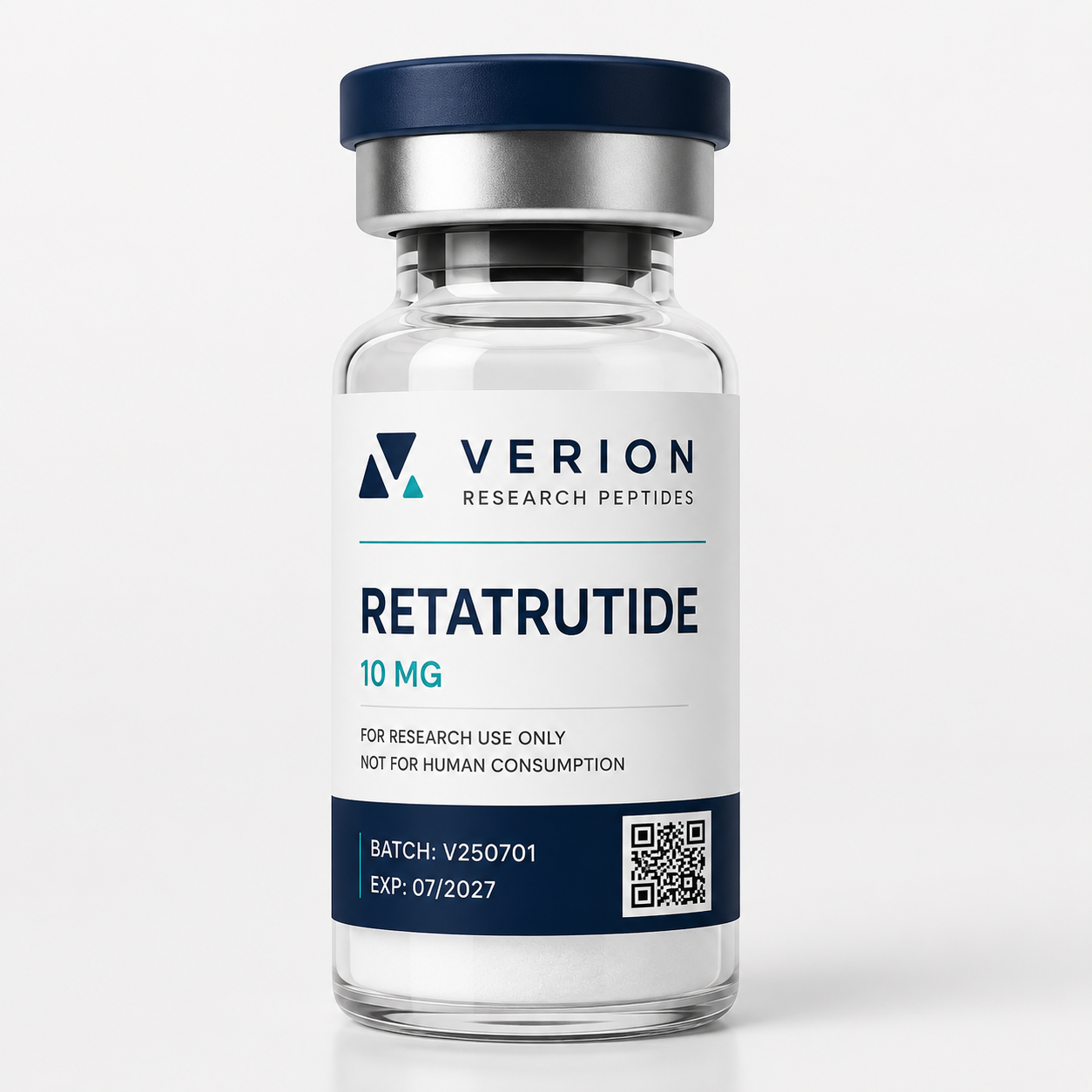
What is retatrutide?
Retatrutide, previously identified in research programmes as LY3437943, is an investigational peptide designed to activate three hormone receptors: the glucose-dependent insulinotropic polypeptide receptor, the glucagon-like peptide-1 receptor and the glucagon receptor.
It is therefore commonly described as a GIP, GLP-1 and glucagon triple-receptor agonist. Its multi-receptor design distinguishes it from single-receptor GLP-1 agonists and dual GIP/GLP-1 agonists.
Retatrutide remains under clinical development. In Australia, it is not included in the Australian Register of Therapeutic Goods as an approved medicine, and the TGA identifies it as an unapproved therapeutic good.
Why are researchers studying retatrutide?
Researchers are examining whether coordinated activity at three metabolic hormone receptors can produce effects that differ from compounds acting at only one or two receptors.
The three receptor systems have distinct but overlapping roles in areas such as nutrient signalling, glucose regulation, appetite-related pathways, gastric function, liver metabolism and energy balance. Retatrutide was designed to investigate the combined pharmacological effects of activating these pathways in a single molecule.
This does not mean that every effect associated with an individual receptor can automatically be attributed to retatrutide. Clinical outcomes need to be established directly through controlled trials.
How does retatrutide work?
GLP-1 receptor activity
GLP-1 is an incretin hormone involved in glucose-dependent insulin secretion and several gastrointestinal and appetite-related signalling pathways.
Activation of the GLP-1 receptor is already an established area of metabolic-drug research. However, retatrutide is not simply a GLP-1 agonist; GLP-1 receptor activity forms only one part of its triple-receptor profile.
GIP receptor activity
GIP is another incretin hormone released in response to nutrient intake. Its receptor is involved in glucose-dependent insulin signalling and broader nutrient-metabolism pathways.
The simultaneous inclusion of GIP and GLP-1 receptor activity is intended to investigate whether their combined signalling produces complementary effects.
Glucagon receptor activity
Glucagon signalling is involved in hepatic glucose regulation, lipid metabolism and energy expenditure.
The glucagon component makes retatrutide pharmacologically distinct from dual GIP/GLP-1 agonists. Researchers continue to investigate how the balance among all three receptor activities contributes to observed clinical results.
What has human research examined?
A published phase 2, double-blind, randomised, placebo-controlled trial evaluated retatrutide in adults with obesity or overweight plus at least one weight-related condition. The study assessed dose response, safety and efficacy over 48 weeks.
The trial reported substantial average changes in body weight across the higher-dose groups. However, those findings need to be understood within the trial’s eligibility criteria, dosing schedule, duration and controlled clinical setting. They do not establish that unregulated or non-trial products are equivalent to the investigational material used in clinical development.
Gastrointestinal adverse events were among the commonly reported events in the phase 2 trial and generally occurred during dose escalation. Clinical-trial findings should not be converted into self-administration guidance.
Is phase 3 research underway?
Retatrutide has entered a broader phase 3 development programme. ClinicalTrials.gov lists studies within the TRIUMPH programme examining retatrutide in populations with obesity and associated conditions. For example, TRIUMPH-3 evaluates efficacy and safety in participants with obesity and established cardiovascular disease and was listed as active but not recruiting in May 2026.
The existence of phase 3 trials does not mean the compound is approved. Phase 3 studies are intended to provide additional evidence regarding efficacy, safety and clinically relevant outcomes before regulators consider an application.
What are the limitations of the evidence?
Several points are important when interpreting retatrutide research:
- Published results come from defined clinical-trial populations and controlled protocols.
- Long-term safety evidence is still developing.
- Phase 3 results may change the current understanding of benefits and risks.
- Trial material manufactured for regulated research should not be assumed to be equivalent to products sold through unverified channels.
- A reported laboratory purity percentage does not establish clinical safety, sterility, dose accuracy or regulatory approval.
- Early or mid-stage clinical findings do not guarantee eventual approval.
Australian health authorities have recently warned about the public-health risks associated with unapproved peptide products and note that such products have not been assessed by the TGA for safety, quality or effectiveness.
Is retatrutide approved in Australia?
No. The TGA currently identifies retatrutide as an unapproved therapeutic good. Unapproved therapeutic goods are not included in the ARTG and have not been assessed by the TGA for safety, quality or effectiveness. Access to unapproved therapeutic goods may occur only through specific legal pathways and circumstances.
The TGA also states that public advertising of retatrutide is prohibited unless an applicable exemption exists.
How should published findings be interpreted?
Readers should distinguish among:
- biochemical or receptor studies;
animal studies;
- phase 1 pharmacology studies;
- phase 2 efficacy and dose-ranging studies;
- phase 3 confirmatory studies;
- regulatory approval; and
- evidence from routine clinical use.
These stages answer different questions. A compound can produce encouraging phase 2 results and still require substantial additional evaluation.
When reviewing a study, examine the participant population, comparison group, duration, endpoints, missing data, adverse events, sponsor involvement and whether results have been replicated.
Frequently asked questions
Is retatrutide the same as semaglutide?
No. Semaglutide acts primarily as a GLP-1 receptor agonist, whereas retatrutide was designed to activate GIP, GLP-1 and glucagon receptors.
Is retatrutide the same as tirzepatide?
No. Tirzepatide is a dual GIP/GLP-1 receptor agonist. Retatrutide adds glucagon receptor activity, giving it a triple-receptor profile.
Has retatrutide been studied in humans?
Yes. Human phase 1 and phase 2 research has been published, and phase 3 studies are underway. It remains investigational.
Does a phase 2 trial mean it is proven safe?
No. Phase 2 trials provide important evidence, but larger and longer studies are needed to characterise safety and efficacy more fully.
Can clinical-trial results be applied to products sold online?
Not automatically. Trial products are manufactured, stored and administered under controlled conditions. Online products may not have equivalent identity, strength, sterility, quality or regulatory oversight.
References
- Jastreboff AM, Kaplan LM, Frías JP, Wu Q, Du Y, Gurbuz S, et al. Triple-Hormone-Receptor Agonist Retatrutide for Obesity – A Phase 2 Trial. N Engl J Med. 2023;389(6):514–526. doi:10.1056/NEJMoa2301972.
- ClinicalTrials.gov. A Study of Retatrutide (LY3437943) in Participants With Obesity and Established Cardiovascular Disease (TRIUMPH-3) [Internet]. Bethesda (MD): U.S. National Library of Medicine; Available from: https://clinicaltrials.gov/study/NCT05882045
- Therapeutic Goods Administration (TGA). Advertising Ozempic and GLP-1 receptor agonists is prohibited [Internet]. Australian Government Department of Health and Aged Care. Available from: https://www.tga.gov.au/products/regulations-all-products/advertising/specialised-advertising-issues-and-topics/advertising-ozempic-and-glp-1-receptor-agonists-prohibited
- Therapeutic Goods Administration (TGA). Concerns regarding public health risks associated with unapproved peptide products [Internet]. Australian Government Department of Health and Aged Care. Available from: https://www.tga.gov.au/news/media-releases/concerns-regarding-public-health-risks-associated-unapproved-peptide-products
Editorial disclaimer
This article is provided for general scientific education. It does not provide medical advice, dosing guidance or a recommendation to obtain or use retatrutide. Retatrutide remains investigational and is not approved for general supply in Australia. Consult the original publications and current TGA information for authoritative details.